Water quality monitor

A raft that tells the club when the river changes

One of Tadpole’s founder clubs, Trim, Athboy & District Angling Association, was quoted €26,000 for a commercial water quality monitor. Few angling clubs can afford this, so we went down the citizen science route and built one with them for the Boyne, for a fraction of the cost. It floats, it reads the water every 15 minutes, and it emails the committee when something shifts.

  • Dissolved oxygen, turbidity and temperature
  • Alerts in Tadpole and by email
  • Built by club volunteers
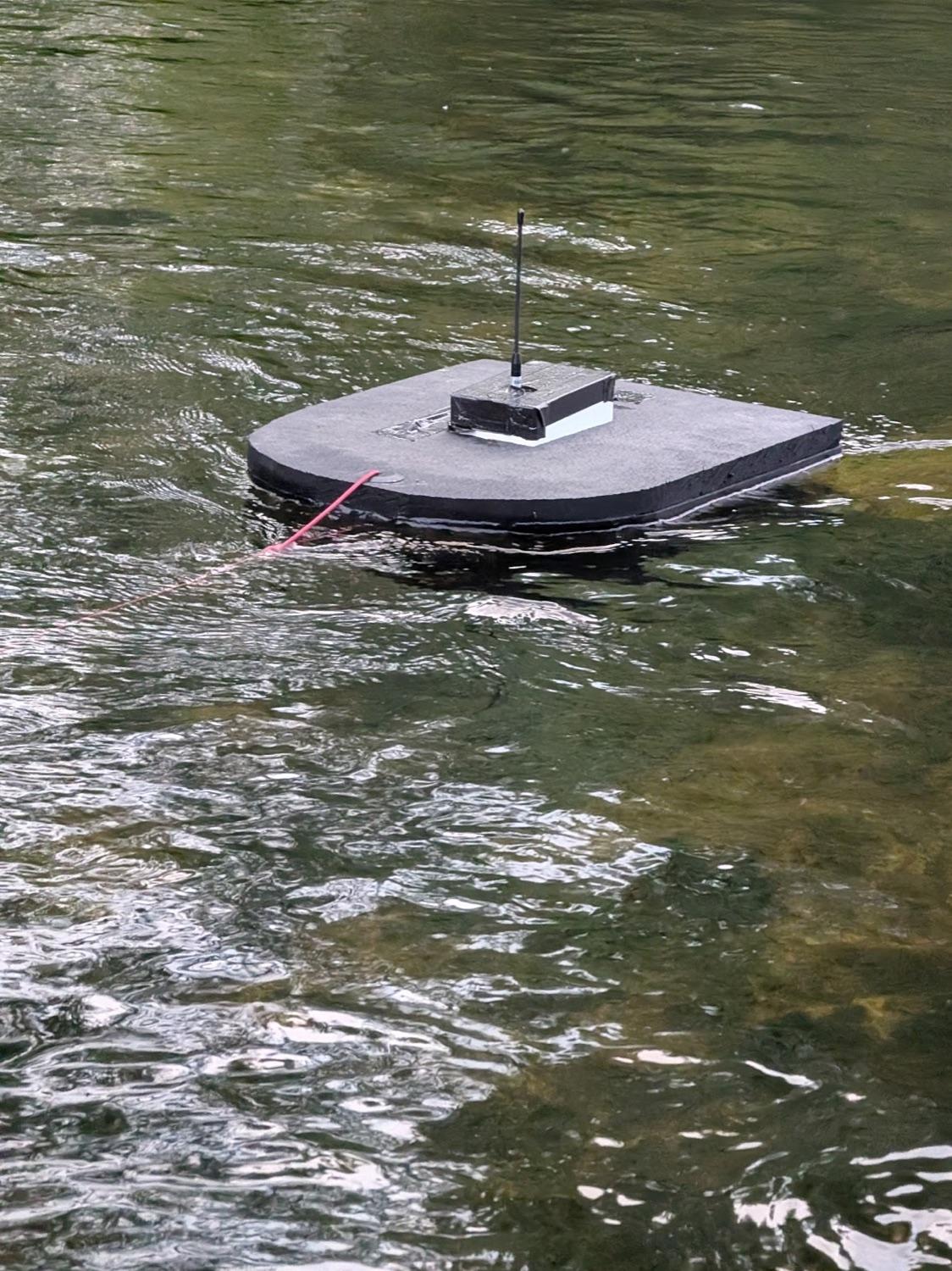
A flat black rubber raft with a small box and antenna, moored in a river
The LoRa raft on the Boyne.

Most clubs hear about a fish kill from a phone call

By the time a member sees dead fish, whatever caused it is miles downstream. Low oxygen, a slurry spill or a discharge shows in the water hours before it shows on the bank, and nobody is standing there at four in the morning.

Commercial monitoring stations exist. The one quoted to Trim, Athboy & District was €26,000. Few angling clubs can afford this. So we took the citizen science route: volunteers, parts a club can buy, and a fair amount of trial and error. Our build cost a fraction of the commercial price, and it gives the club the same real-time monitoring and alerts.

What it measures

Three probes hang under the raft. Each one answers a different question about the water.

Dissolved oxygen

The oxygen in the water that fish breathe.

A sudden drop is what kills fish. It is often the first sign of slurry, sewage or an algal bloom, so this is the reading the monitor watches most closely.

Turbidity

How cloudy the water is.

The probe shines a light into the water and measures how much is scattered by the particles in it. Rain colours a river gradually. A sharp jump with no rise in level points to silt, run-off or a discharge.

Temperature

How warm the water is.

Warm water holds less oxygen, and trout and salmon feel it first. Temperature also helps make sense of the other two readings.

From the river to the committee’s inbox

  1. 01

    The raft reads the water

    Probes hang under a rubber raft moored in the river and take a reading every 15 minutes.

  2. 02

    It learns what normal is

    The software keeps a running baseline for each probe, so it reacts to a sustained change and ignores one odd reading.

  3. 03

    It checks the river level

    A change during a flood is usually the flood. Each event is compared with the nearest OPW river gauge.

  4. 04

    The committee is told

    An alert arrives in Tadpole and by email with the reading, the baseline and the river context.

It is an early warning. It is a signal to go and take a sample. The monitor tells the club when to go to the river. The accredited lab result is the proof, and the dashboard keeps both side by side.

Two types, depending on where your water is

Both rafts measure the same three things. The difference is how the readings get home.

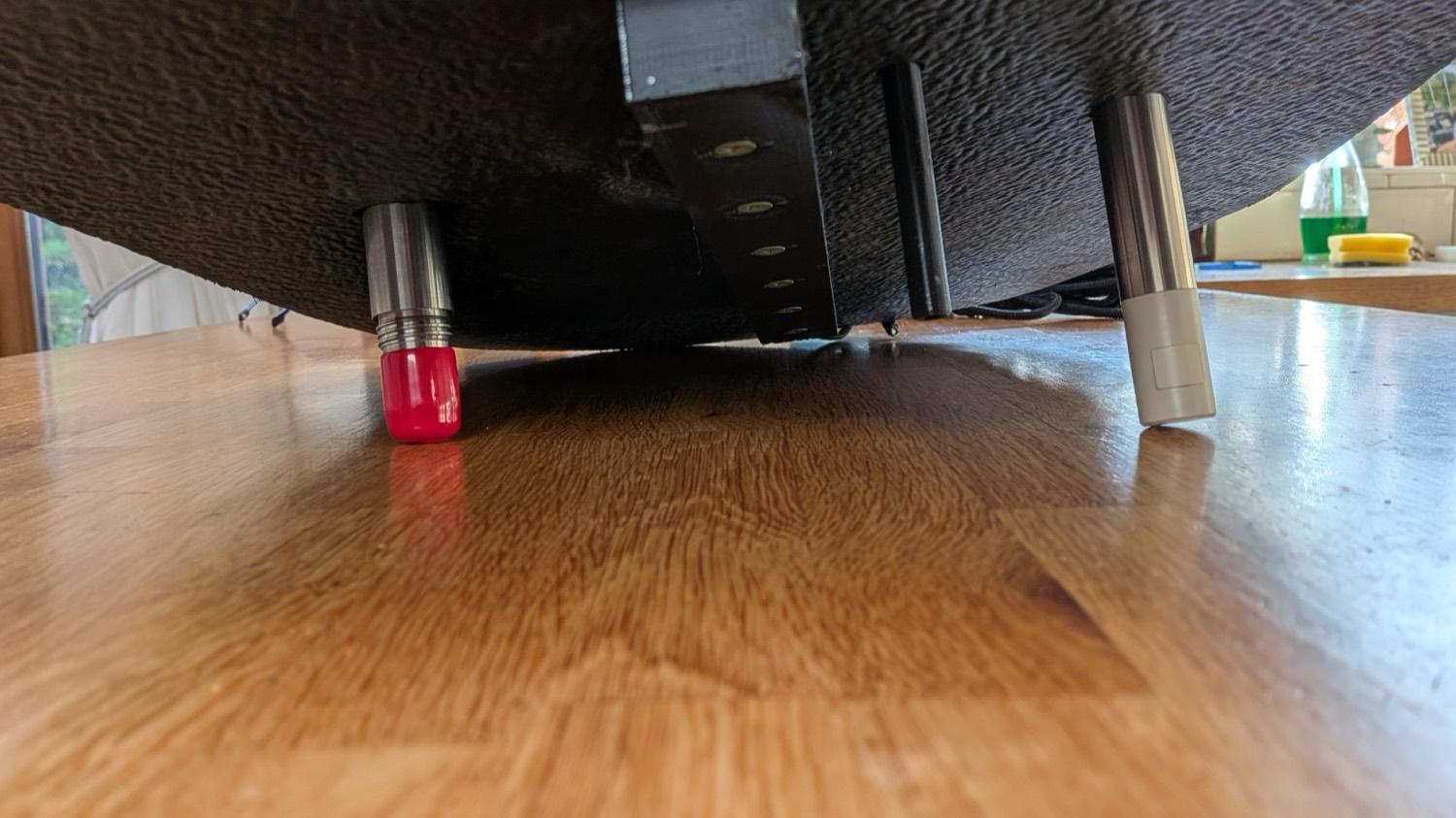
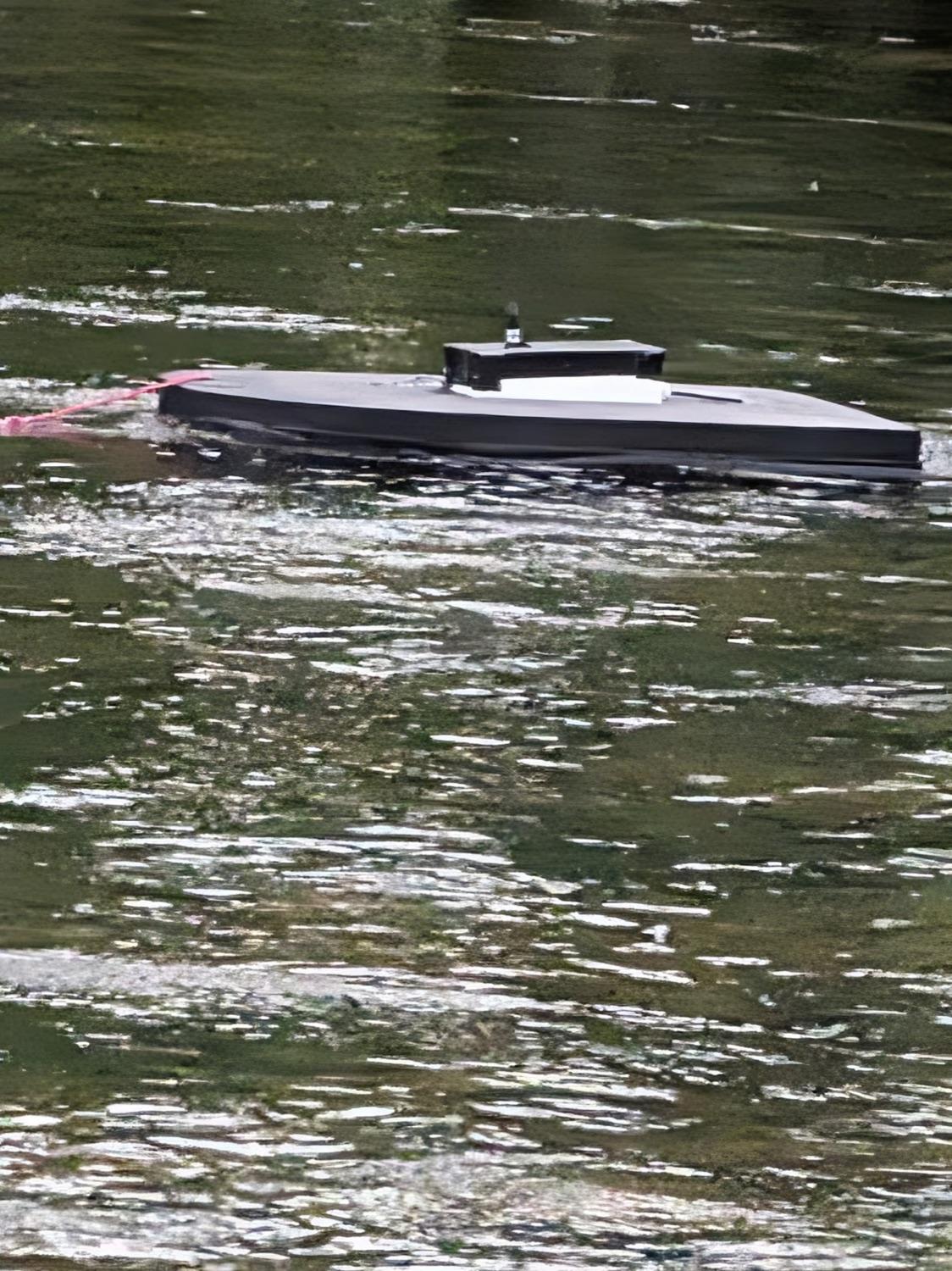
The LoRa raft seen from the bank, antenna up, on a red mooring ropeThe LoRa raft side-on, low in the water

LoRa raft · long-range radio

No SIM and nothing to pay each month

The raft sends each reading by long-range radio (LoRa) to a small receiver in a window. A Raspberry Pi beside it works out whether anything has changed and passes it to Tadpole.

It suits a stretch within radio reach of a building with power and broadband. This is the one that has been out on the Boyne.
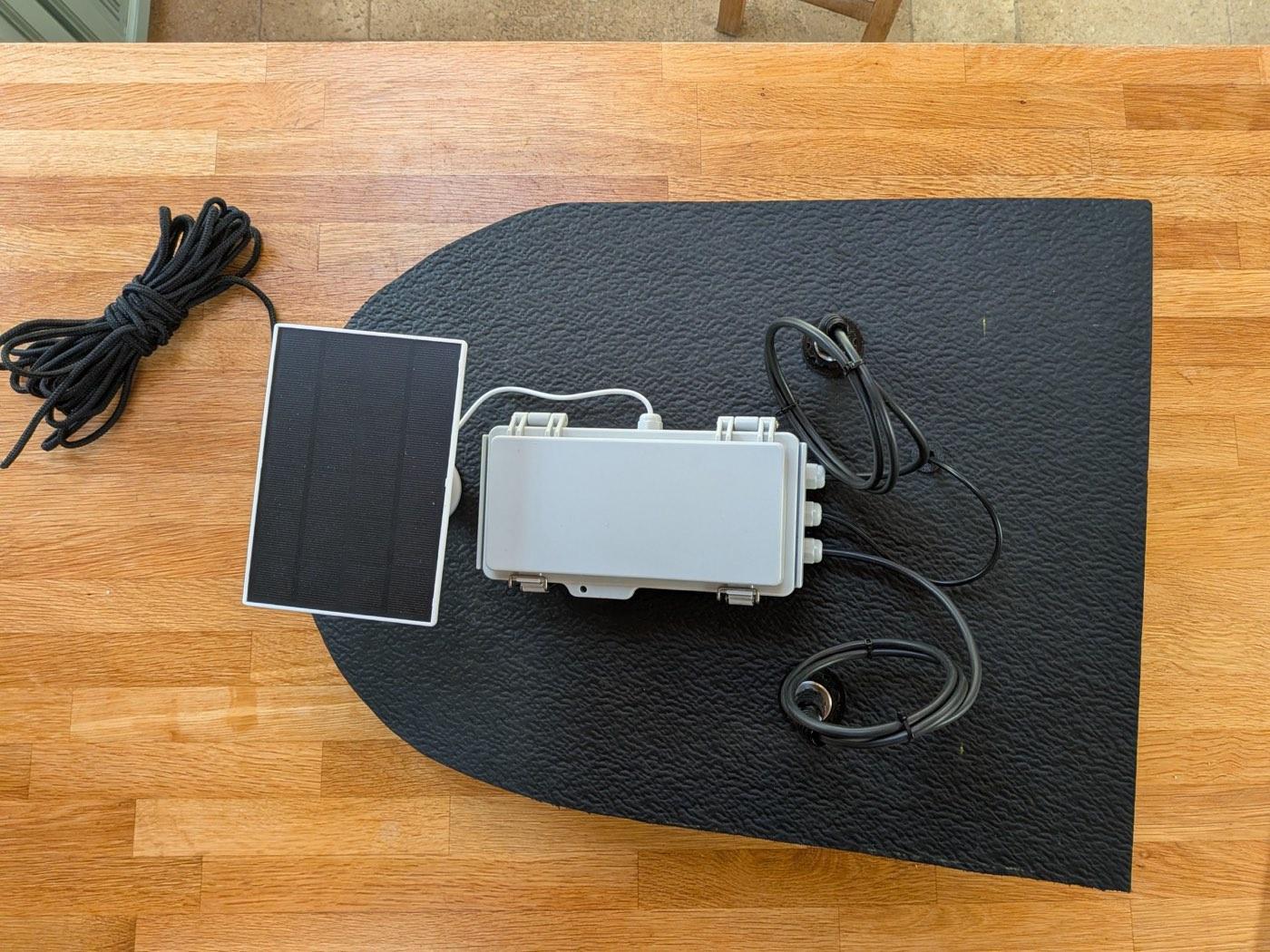
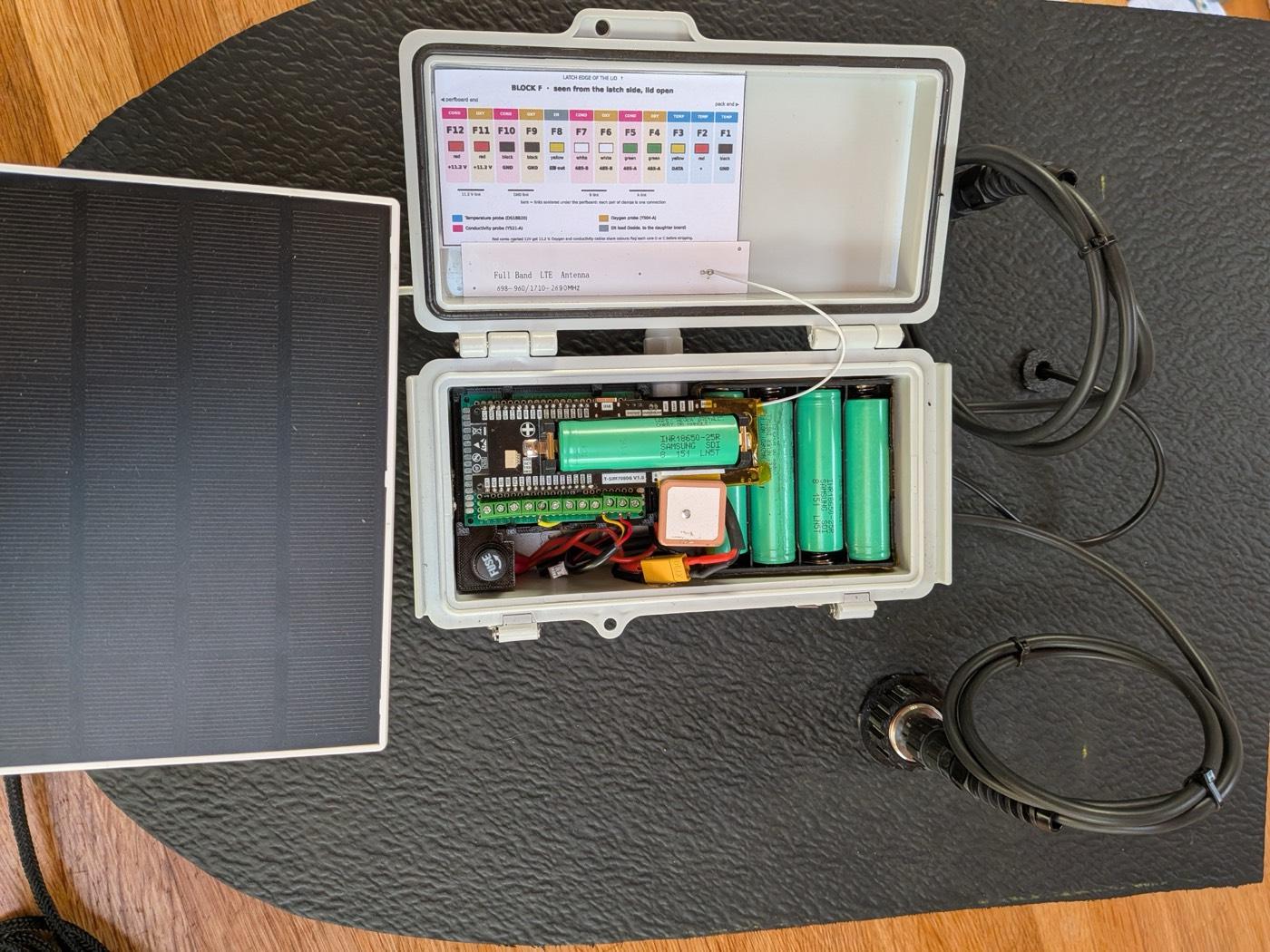
The IoT raft from above: solar panel, sealed grey box and probe cables on a black rubber deckThe IoT raft’s box open, showing the board, battery cells and GPS antennaUnderside of the IoT raft with two steel probes hanging below the deck

IoT raft · mobile network

Its own SIM and its own solar panel

Each raft talks straight to Tadpole over the mobile IoT network, so there is no receiver and no base station. It goes anywhere with coverage.

GPS reports where it is. Sensors in the box report tilt, humidity and battery, so the club knows if the raft has turned over, started to leak or left its mooring. Built in November 2026 and shown at the Irish Fly Fair in Enniskillen.

What the committee sees

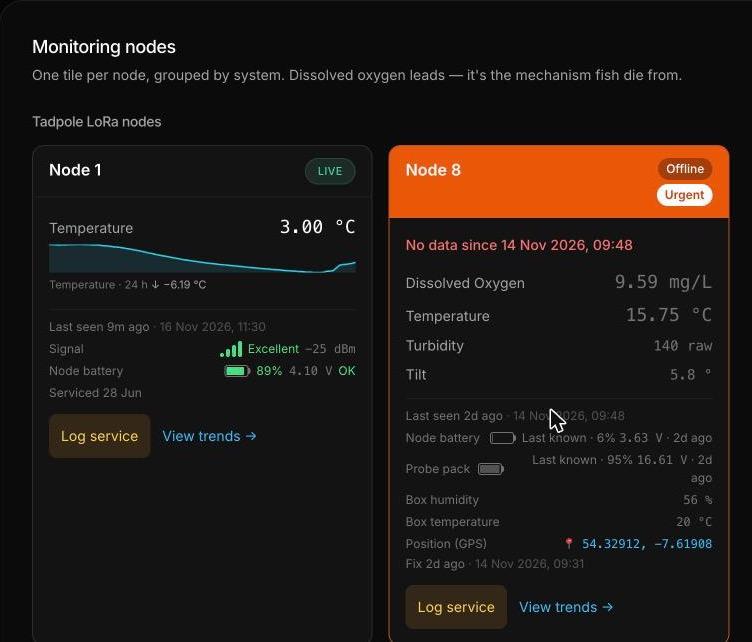
Every raft gets a tile on the club’s Tadpole dashboard. Green means it is reporting and the water looks normal. A raft that goes quiet is flagged before anyone has to wonder.

Dashboard tiles for two rafts, showing latest readings, signal and battery
One tile per raft: latest readings, signal, battery, and when it was last heard from.
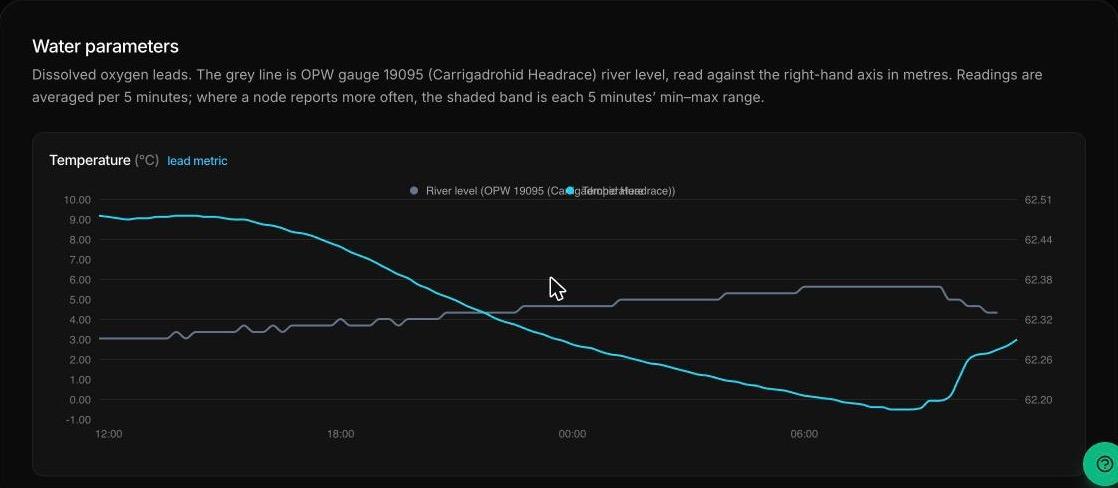
A 24 hour temperature chart with the OPW river level overlaid in grey
Each reading charted against the OPW river level, so a spate is easy to tell from something else.
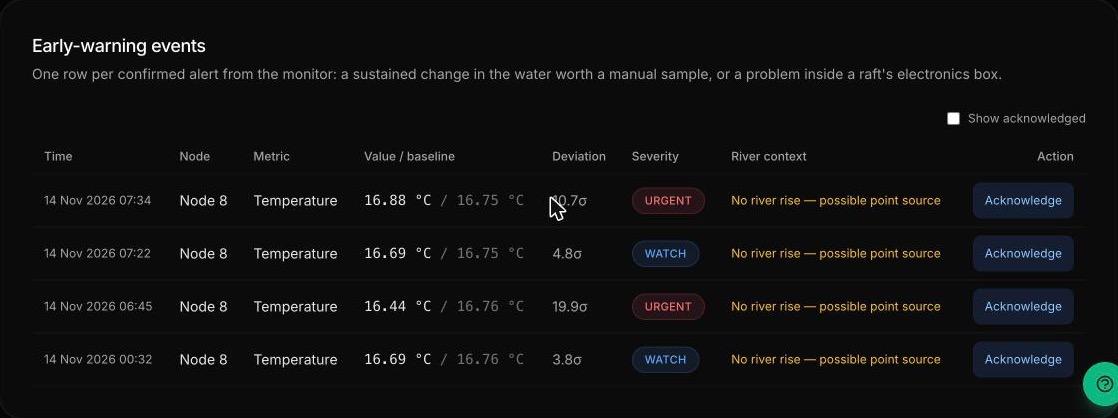
A table of early-warning events with value, baseline, deviation, severity and river context
Every alert is logged with the reading, the baseline and what the river was doing. A committee member acknowledges it and records the sample.

What lands in the inbox

The email is short on purpose. It says which raft, which reading, how far it moved from normal and whether the river was rising at the time.

Then it tells the reader what to do: go and take a sample. One link opens the dashboard to acknowledge the alert and log it.

Water quality urgent: Dissolved Oxygen at Node 1

Tadpole · to the committee

A water-quality early-warning event was recorded for your club.

SeverityUrgent
NodeNode 1
ParameterDissolved Oxygen
Reading5.2 mg/L
Baseline9.4 mg/L
Deviation6.1σ
River contextNo river rise, possible point source

This is a signal to go take a manual sample. It is not a lab measurement.

Open the Water Quality dashboard to acknowledge or log a sample.

Example values, laid out in the wording of the alert email.

Questions clubs ask

Does it replace lab testing?
No. It watches for spikes, not absolute values. A spike is the signal to go and check the water, take samples and call the agency responsible: the EPA, Inland Fisheries Ireland or the local authority in the Republic, and the Northern Ireland Environment Agency, DAERA Inland Fisheries or the Loughs Agency in Northern Ireland. The lab result is the evidence.
What does it measure?
Dissolved oxygen, turbidity (how cloudy the water is) and water temperature, on both the LoRa raft and the IoT raft. Dissolved oxygen leads, because low oxygen is what kills fish. The river level comes from the OPW’s own gauges.
What does it cost to run?
The LoRa raft costs nothing to run beyond the electricity for the receiver. The IoT raft needs a prepaid IoT SIM, which is about €10 for ten years.
Can our club have one?
Get in touch. We are happy to talk through how ours is built, what it involved and what went wrong along the way. If your club already runs on Tadpole, the dashboard and the alerts are there waiting for it.

Want one for your club, or want to help develop it?

This is a volunteer project and we want to keep improving it. If your club would like a monitor, or you have electronics, software or water-science skills to offer, contact us.

Contact us
Encrypted & Isolated
GDPR Built In
Junior Protection
Full Audit Trail
How we protect your data